
Color Bus Trip
VOODOOPuzzle
4.6382.00 Reviews
- Version
- 1.18.0
- Installs
- 1.00M
- Age Rating
- Everyone
Screenshots
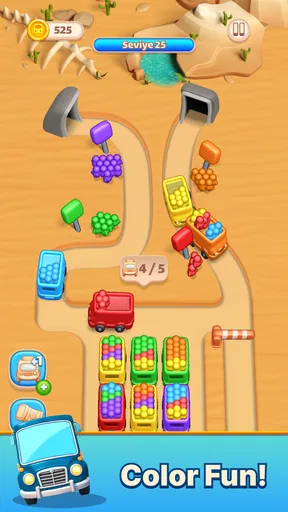
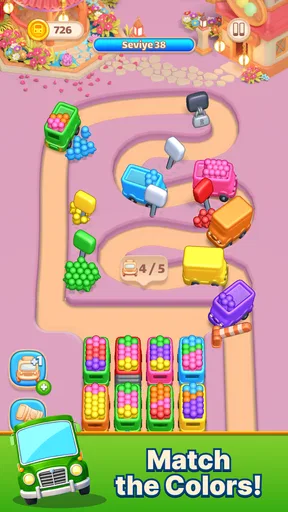
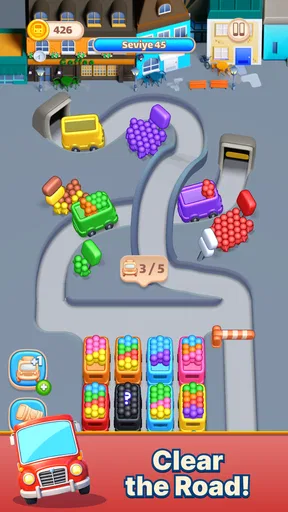

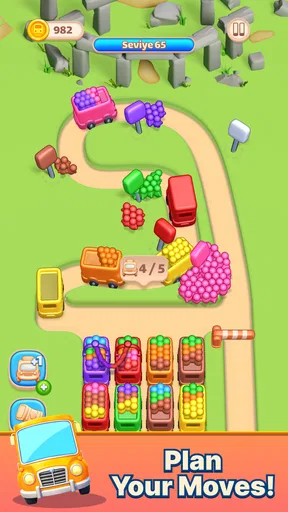

Our Review of Color Bus Trip
 Analysis by Appyee
I can usually tell within a few minutes whether a puzzle game understands the value of my time. Color Bus Trip makes a good first impression because its central idea is immediately readable: buses arrive, passengers need matching colors, and I tap to keep the pickup process moving. There is no long tutorial to decode and no complicated story competing for attention. I can start playing almost instantly, which is exactly what I want when I have a short break rather than a full evening to spare.
Developed by VOODOO, this free puzzle game belongs to the sort-and-match side of casual mobile gaming. Its store summary describes the basic loop accurately, but the real appeal is the small amount of thought hidden inside those simple taps. The challenge is not merely identifying colors. I have to notice the order in which buses can be used, avoid filling useful spaces too early, and decide whether a move helps the current pickup or quietly creates a problem a few turns later.
The game is rated for Everyone, runs on Android starting with version 8.0, and the current release is 1.18.0. Those details make it easy to approach as a broadly accessible time-filler, but accessibility does not mean there is nothing to learn. The early stages are comfortable enough for relaxed play, while later decisions ask for more planning than the bright presentation initially suggests.
Why the first few minutes work so well
The strongest part of the experience is the instant hook. I do not need to memorize a large ruleset before making a meaningful decision. The colors communicate the objective, the buses give each move a visible purpose, and the board makes success or failure easy to understand. That clarity matters on a phone, where I may be playing with one hand and only half my attention.
What I enjoy most is the connection between action and result. A tap is not an abstract match that disappears into a score counter; it sends a bus toward a practical goal. When the correct passengers are collected, the board visibly becomes more orderly. That sense of clearing a small obstruction is satisfying without demanding the dramatic effects or constant urgency found in many arcade alternatives.
The design also makes the game approachable for people who do not normally seek out puzzle titles. Someone can understand the objective by watching a single round, then begin making choices. At the same time, the color arrangement creates enough uncertainty to prevent every level from feeling like a completely automatic sequence. I found myself looking beyond the obvious matching move and checking what it would leave behind.
That distinction is important. A weaker sorting game can feel like tapping the only available answer, while this one works best when I treat each bus as part of a short plan. The pleasure comes from recognizing a useful order before committing. It is a modest kind of strategy, but it gives the game more substance than its cheerful appearance might suggest.
A rhythm built for small gaps in the day
Color Bus Trip is at its best in short sessions. I can play while waiting for a coffee, during a commute break, or between two larger tasks without needing to remember a complicated narrative or rebuild a mental map. Each round presents a contained problem, so the game feels complete even when I only have a few minutes available.
The session rhythm is gentle rather than frantic. I am usually thinking about the next useful tap, not reacting to a timer or trying to maintain a long chain. That makes the game comfortable when I am tired. It also means the experience works well as a mental reset: the board gives me something concrete to organize, but it does not ask me to perform at high speed.
There is a useful difference between “easy to start” and “empty.” The opening is simple, but the sorting decisions can become awkward when I use a convenient color too early. A bus that looks helpful now may remove the space or arrangement I need for the next pickup. I learned to pause briefly before tapping, especially when several colors appear to be available. That tiny habit makes the game feel more deliberate without turning it into a heavy logic exercise.
For an everyday example, I would use it during a ten-minute wait at an appointment. I could complete a few decisions, put the phone away when my name is called, and return later without feeling that I had abandoned a long-running task. It is not a game I would choose when I want a deep, uninterrupted puzzle marathon. Its strength is that a small amount of attention still produces a satisfying result.
What happens when real life interrupts
Interruption tolerance is one of the reasons I find the format practical. The game is structured around individual puzzle situations rather than a continuous story, so an unexpected message or conversation does not ruin a carefully built narrative state. I can stop thinking about buses and colors, handle something else, and come back when I am ready.
That does not mean every interruption is completely frictionless. If I leave the game in the middle of a decision, I may need a moment to reconstruct which color was useful and which space I was protecting. My best habit is to finish a clear move before switching away whenever possible. The board is visually simple enough that returning is usually manageable, but the game still rewards a little awareness at the moment I pause.
This is where it compares favorably with action-oriented casual games. A fast arcade title may punish me for looking away, while a competitive multiplayer game can make a short interruption unfair to other players. Here, the cost is mostly personal: I may lose my train of thought, but I am not damaging someone else’s match or missing a critical timed event.
I would still avoid opening it when I need to be fully attentive to another activity. The colorful board encourages “just one more move,” and a puzzle that looks finished can reveal one final awkward arrangement. It is interruption-friendly, not interruption-proof. That difference matters if I am playing while walking, working, or supervising something that needs my attention.
The small decisions that improve a run
The most useful technique I found is to identify the bottleneck before choosing the easiest match. I look for the color or bus that has the fewest practical routes, then consider whether clearing it now opens space for several later moves. This is more reliable than simply selecting whichever pair looks immediately available.
A second useful habit is to protect flexibility. When two moves seem equally good, I prefer the one that leaves more colors accessible and avoids creating a crowded section of the board. In sorting puzzles, an open arrangement is valuable because it gives me options. A move that solves one pickup but blocks the next few choices can be worse than a slower move that keeps the board adaptable.
I also try not to treat every successful pickup as proof that the previous choice was correct. Sometimes a move works locally while making the overall arrangement less convenient. Watching the remaining colors after each action helps me spot these traps. This is a small but meaningful step up from pure matching: I am managing the future shape of the puzzle, not only the current color.
These observations are not advanced systems hidden behind a menu; they are practical ways to play more intelligently. They also explain why the game can hold my attention beyond the first novelty. The rules remain simple, but my own approach becomes more refined. I start by tapping what is obvious and gradually learn to preserve options, anticipate congestion, and use the buses in a better order.
Where the repetition begins to show
The same simplicity that makes the opening inviting can eventually limit the experience. The core action remains centered on colors, buses, and pickups, so players looking for radically different mechanics may begin to feel that they are solving variations of one idea. The game can be pleasant for repeated short visits, but it is not designed to replace a larger puzzle collection for someone who wants constant novelty.
My enjoyment depends heavily on how much I like incremental sorting. If arranging a crowded board into a clean sequence feels rewarding to you, the repetition can become calming. If you need new rules, story developments, or increasingly unusual objectives to maintain interest, the basic loop may feel narrow sooner than expected.
This is also where the comparison with traditional match-three games becomes useful. Match-three titles often rely on cascades, chain reactions, and quick visual rewards. Color Bus Trip is more orderly and more spatially cautious. I spend less time chasing a flashy sequence and more time deciding which move keeps the board workable. Neither approach is automatically better, but the difference affects who will enjoy returning to it.
Compared with classic block-placement puzzles, it offers a more guided objective. I am not simply fitting shapes into empty space; I am trying to coordinate pickups by color. That makes the game easier to understand at first, though it may provide less room for the kind of open-ended optimization that keeps dedicated puzzle fans engaged for long sessions.
The game’s rating history suggests that many players have found the formula appealing: it holds an average of 4.6 from around 11 thousand ratings, with over a thousand downloads indicated by its install figure. I read that as evidence of broad casual appeal rather than a guarantee that every player will enjoy extended repetition. A popular short-session game can still be the wrong choice for someone seeking depth or variety.
Free access and the practical trade-off
The game is free to play, which makes trying the central puzzle loop straightforward. There are in-app purchases ranging from $1.99 to $99.99 per item, so anyone who dislikes optional spending should approach the purchase layer carefully. I would decide in advance whether I am comfortable playing only with the free path and avoid treating every extra convenience as necessary.
That matters especially in a simple puzzle game. When the basic action is easy to understand, any purchase prompt or progression friction can feel more noticeable because the player is there for a clean, relaxing loop. My preferred way to use it is to judge the free experience on its own: if the ordinary rounds are already enjoyable, the game has earned its place as a casual pastime; if I need repeated purchases to stay comfortable, the value becomes less convincing.
The age rating of Everyone is another practical advantage for shared devices and family settings. The colorful presentation and straightforward rules are approachable, although younger players may still benefit from learning the planning habits rather than tapping randomly. Adults who want a quiet distraction can enjoy the same structure without needing to engage with complicated themes.
Because the game is from VOODOO and the current version is 1.18.0, I would keep the app updated through the usual platform store rather than relying on an old installation. That is sensible for any mobile game, particularly one whose balance and level flow may evolve over time. I would also check the device requirement before installing: Android users need version 8.0 or later.
Who should play it, and who should skip it
I recommend it to people who want a puzzle they can understand immediately and revisit in short bursts. It is especially suitable if you enjoy visual organization, prefer calm decision-making to reflex challenges, and like the feeling of turning a cluttered arrangement into a clean sequence. It also suits players who often have interrupted free time and do not want a game built around a long campaign.
I would be more cautious recommending it to someone who wants a rich story, competitive matches, elaborate power systems, or a large range of puzzle types. It is also not my first choice for a serious logic enthusiast looking for unusually deep deduction. The game offers planning, but it keeps that planning within a bright, accessible framework.
Players who are sensitive to optional purchases should make their own spending boundary before playing. The free entry point is useful, but the presence of items at several price levels means the overall experience is not the same as a one-time paid puzzle. If you prefer to buy a complete game once and avoid any purchase decisions afterward, a premium puzzle alternative may be a better fit.
For me, the deciding question is not whether the game can provide hours of uninterrupted complexity. It cannot compete on that specific measure with a substantial puzzle campaign. The better question is whether a few minutes of sorting can feel worthwhile. Most of the time, the answer is yes.
My casual verdict after living with the loop
Color Bus Trip succeeds because it respects the first few seconds of a player’s attention. I can see what to do, make a move, and understand the result without studying instructions. Beneath that friendly surface, the order of actions matters enough to create genuine small-scale decisions. That combination gives the game its best quality: immediate pleasure with just enough thought to keep the taps from becoming automatic.
Its replay value is steady rather than limitless. I return when I want a contained sorting challenge, not when I am searching for a new world or a major strategic project. The repetition becomes easier to accept because the game works well as a background companion to ordinary waiting, but players who need constant mechanical surprises may outgrow it.
The most honest recommendation I can give is this: try it if you want a free, accessible puzzle for brief sessions and enjoy planning around colors and space. Keep your expectations realistic about depth, optional spending, and long-term variety. Its real strength is not complexity; it is the clean handoff from “I have a minute” to “that was satisfying.”
With its Everyone rating, broad device compatibility from Android 8.0 onward, and simple pickup-based structure, it is easy to understand why the game has reached a wide casual audience. I would keep it installed for waiting rooms, quiet breaks, and those moments when I want my attention occupied without being overwhelmed. It is a modest puzzle, but a well-focused one—and for this kind of everyday use, that focus is exactly what makes it worth recommending.
Verdict
Strengths of Color Bus Trip
- Simple controls make it easy to start playing immediately.
- Short levels are convenient for quick gaming sessions.
- Colorful visuals make the buses and routes easy to distinguish.
- Gradually increasing difficulty keeps the gameplay engaging.
- Works well for players who enjoy casual puzzle challenges.
Limitations of Color Bus Trip
- Some levels may feel repetitive after extended play.
- Later puzzles can depend heavily on trial and error.
- Ads may interrupt the game between levels.
- Limited strategic depth may disappoint experienced puzzle players.
- Performance can vary on older phones or tablets.
Other Releases by VOODOO
View All


Similar Picks in This Category
View All
Block Blast!
HungryStudio4.8

Braindom: Brain Games Test
Lahana Game Studio4.6

AMAZE!
CrazyLabs LTD4.6

Sudoku - Classic Sudoku Puzzle
Oakever Games4.7

Art Puzzle - Puzzle Games
Easybrain4.8

Amaze GO!
Oakever Games4.9
Frequently Asked Questions
What is Color Bus Trip and how do you play it?
Color Bus Trip is a casual puzzle game built around matching colorful passengers with buses of the same color. During each level, you tap, arrange, or manage passengers and vehicles while considering the available spaces and the order of moves. The early stages are easy to understand, but later puzzles require more planning to avoid blocking the board and running out of useful moves.
Is Color Bus Trip free to download and play?
Color Bus Trip can generally be downloaded for free on supported Android or iOS devices, allowing you to try the main gameplay without an upfront purchase. However, the game may include optional in-app purchases for coins, boosters, extra moves, or other helpful items. Advertising may also appear between levels or during bonus opportunities, so the overall experience is free but not necessarily completely ad-free.
Does Color Bus Trip require an internet connection?
The basic puzzle levels in Color Bus Trip may be playable without a constant internet connection, which makes the game convenient for short sessions while traveling or when mobile data is unavailable. Nevertheless, certain features can depend on connectivity, including advertisements, cloud saving, events, leaderboards, updates, and purchases. Availability may vary by version, so it is best to open the game online after installation.
Is Color Bus Trip suitable for children and casual players?
Color Bus Trip is designed to be easy to learn, with simple tap-based controls and colorful visuals that make it approachable for casual players. It does not require advanced gaming experience, although some later levels can become challenging and may encourage the use of hints or extra moves. Parents should still check the store rating, advertising, and in-app purchase settings before allowing children to play.
What should I know about ads, boosters, and in-app purchases in Color Bus Trip?
The game may use advertisements and optional purchases as part of its progression system. You can usually complete levels without buying anything, but difficult stages may offer boosters, additional moves, coins, or retries to reduce frustration. Some rewards may be available by watching an advertisement, while purchases can speed up progress. Review the payment settings on your device, especially if children use the same account.
Play our best games!


